
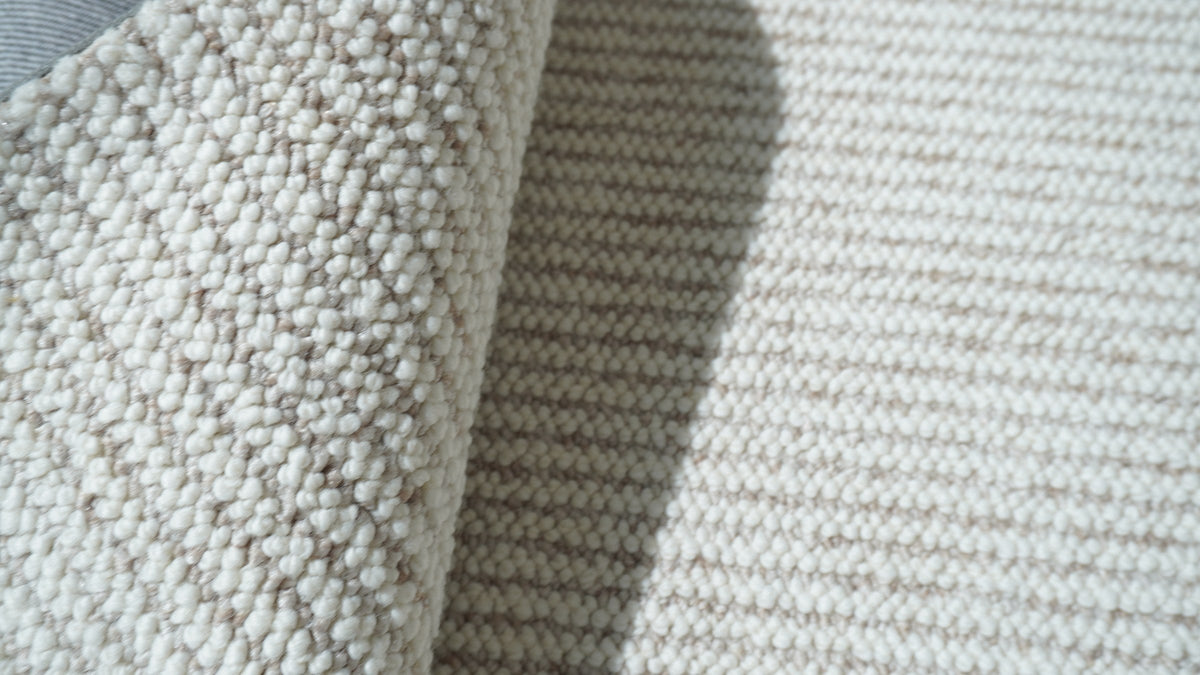
For timber floors and linen upholstery, specify a matte, tonally varied loop or pebbled rug in warm cream, greige or sand. Texture supplies the depth, so colour can stay quiet. Keep the rug a step lighter or darker than the floor, never a match, and if the client will live on it before the photos are taken, make it a low-shed wool blend.
The brief recurs. An oak-toned floor, an oat linen sofa, and a client who says they don't want anything loud. This post works through the texture vocabulary, pairing by floor species and by upholstery, how relief behaves in afternoon light, which finishes date, and what a wool blend gives and gives up against hand-knotted wool. Four Elmsett rugs close it out as worked examples. We sell New Zealand wool-blend rugs, so we have a stake here, and we say where ours is the wrong rug.
Why does texture do the work in a linen and timber room?
Because both materials already carry tone and grain. Linen has slub and a visible weave. Timber has figure, gum vein and colour movement from board to board. A patterned rug adds a third voice and the room starts talking over itself.
A textured rug in a close tone adds a surface rather than an image. Its depth comes from shadow in the pile, which shifts with the light, rather than from a contrast the eye has to keep resolving. The room reads as calm at a glance and rewards a second look.
If the client asks for "a bit of interest", give it in relief, not in print.
What do the texture terms mean?
- Loop pile. Yarn left as uncut loops. Reads as a fine, even grain up close and as a soft solid from the doorway. Firm and slightly springy underfoot. Holds its fibre better than cut pile because each loop is anchored at both ends.
- Bouclé. A loop pile made from a curled, knobbly yarn, so the loops sit at uneven heights. Reads woolly and relaxed. Soft underfoot with a slight unevenness you can feel through socks.
- Pebbled. Rounded loops gathered in irregular clusters. Reads like a shingle beach from across the room, dimpled up close. Comfortable, with small pockets of shadow between the clusters.
- Corded or ribbed. Loops arranged in raised rows. Reads as stripes in low light and as a plain surface in flat light. Firm and directional underfoot.
- Flecked. Two or more tones twisted into the yarn so colour breaks across the surface. Reads as a soft speckle. Forgives crumbs and the odd mark better than any plain colour.
- Flatweave. No pile at all; the weave is the surface. Reads crisp and thin. Hard underfoot, light to move, nothing to shed and little to cushion.
- Cut pile. Loops sheared open so the yarn ends stand up. The softest hand and the most shedding, since every tuft has two loose ends. In a plain colour it shows footprints and vacuum tracks.
Which rug tone suits which timber floor?
The trap is matching. A greige rug on a greige-toned engineered oak disappears, and the room looks carpeted wall to wall, with a seam. Pick a tone that does one of three jobs instead: lift (a step lighter than the floor), ground (a step darker) or bridge (sitting between the floor and the sofa).
| Floor | How it reads | Rug tone to specify | Texture that helps |
|---|---|---|---|
| Blackbutt | Pale cream to warm honey, a slight pink tinge, fairly even grain | Greige or soft taupe, to ground it. Cream risks washing the room out | Corded loop; the rows give a pale room some structure |
| Spotted Gum | Light coffee brown to dark chocolate with reddish tinges, wide board-to-board variation | Warm sand or cream, to lift. Avoid cool grey, it argues with the red | Chunky fleck or pebble; the floor is busy, so the rug should be calm but not flat |
| Tasmanian Oak | Pale straw to light red-brown with pink hues | Ivory or warm cream, a step lighter. Greige bridges a pink floor and an oat sofa | Pebbled loop |
| Victorian Ash | Pale pink to pale yellow or brownish | Cream with a sandy or gold fleck picks up the yellow. Avoid stark white | Irregular loop with fleck |
| Pale engineered oak (limed, white-oiled, Scandinavian) | Near-white to pale grey-beige | Greige or taupe, to ground. A white rug makes the room read unfinished | Corded loop, so the rug is not another flat pale plane |
| Dark stained or walnut-tone | Deep brown, often on the cool side | Cream or ivory, to lift. The contrast is the point | Pebbled or bouclé, for softness against the hardness |
Species colour notes are drawn from Australian timber suppliers and WoodSolutions; the sources are listed at the end. Floors vary by grade, finish and age, so read the actual boards, not the species name.
How much contrast with the upholstery keeps the room calm?
One step. Not zero, which makes a beige block, and not three, which makes a target.
- Oat or flax linen. Rug a shade lighter (ivory) or a shade warmer (sand with a gold fleck). Rug and sofa in the same tone merge into one lump of beige.
- White linen. The rug needs a mid tone or a texture with real shadow in it: a soft-gold ground with ivory cords, or cream with taupe between the rows. White on white on pale oak looks clinical.
- Charcoal linen. The rug is the light in the room. Cream with a corded relief gives a dark sofa something to sit on without a hard edge around it.
- Leather, tan or cognac. Greige or taupe. Leather is already warm and slightly glossy, so the rug should be matte and a notch cooler.
- Bouclé upholstery. Texture on texture works when the scales differ. Put a corded rug under a chunky bouclé armchair, or a chunky pebbled rug under a smooth sofa. Don't match the scale; the pieces will fight for the same job.
How does a raised texture behave in afternoon light?
A raised cord or pebble casts a shadow on its own surface. In low, raking light the rug reads darker and more structured than it did at midday, and the rows or clusters become visible from across the room. A flat cut pile has nothing to cast a shadow, so it looks the same all day, which is why a plain rug can seem lifeless in a north-facing room at four in the afternoon.
This is also why rug photography misleads. Our own Help page tells customers that a wool-blend pile "changes appearance with the direction of the light and the lie of the pile", and that applies to every textured rug, not only ours.
Check a sample at two times of day if you can. If you can't, lean toward a defined relief, so the rug has somewhere to go when the light drops.
Which finishes hold up across client interiors?
The finishes that date are the ones that announce a year.
- Shag and long pile. Flattens in traffic lanes, traps everything, and pins the room to a decade.
- High-contrast geometric pattern. Locks the room to the season the pattern was fashionable and limits what can change around it.
- High-lustre viscose and bamboo silk. Beautiful on day one, then every footprint, chair leg and drop of water shows.
The finishes that don't date are the ones that could have come from any decade: tonal loop, undyed-look neutrals, and flecked yarns where the colour sits in the fibre rather than on the surface. A client can repaint, re-cover the sofa and change the art, and the rug still belongs.
If a rug would look wrong under a different sofa, it is the wrong rug for a client who will own it for ten years.
Does a wool blend shed less than hand-knotted wool?
Yes, and it is a trade worth understanding before you specify either.
Hand-knotted and hand-loomed 100% wool rugs typically shed for one to three months by trade accounts, with the heaviest loss in the first six weeks and some hand-tufted rugs continuing for longer (shop-jubi.com; atlantadesignerrugs.com). Wool is a staple fibre: short strands spun together, which work loose under foot and vacuum. Nylon, polyester and polypropylene are often continuous filaments, long and smooth, so they have far less to give up (edwardmartin.com).
Blend them with New Zealand wool and the loose-fibre count drops. Loop construction does the rest. A loop is anchored at both ends, so the fibre stays in the rug rather than on the floor and the sofa. Our rugs settle in 2–6 weeks with regular vacuuming, and we say low-shed, never shed-free, because a wool-blend pile does shed a little while it settles.
Here is what a blend gives up. It is not hand-knotted. You lose the knot-by-knot variation and the abrash (the soft colour drift between dye lots that handmade rugs carry), the heirloom story, and the resale value. What you get is a rug a family can live on from the first week, a shorter settling period, and a price under $650 for 200 × 300 cm. If the client has the budget, the patience and no pets, a hand-knotted piece is a fine specification. Most briefs have at least one of those three missing.
The wool in Elmsett rugs is New Zealand wool. Each product page names the synthetic fibres in that rug's blend.
Specify a textured wool-blend loop if
- the floor is timber and the sofa is linen
- the client wants quiet
- there are children, pets or both
- the rug has to look right in week one
- the budget sits around $500–700
Don't specify it if
- the client wants a hand-knotted heirloom with visible abrash
- the room needs a pattern to carry it
- the space is a bathroom, laundry or outdoor area
Which Elmsett rug suits which scheme?
Four rugs, four recurring briefs. Our current rugs are 200 × 300 cm, New Zealand wool blends, and delivered free Australia-wide.
Glint, $549
Wool blended with nylon and polypropylene. Rows of ivory loops trace through a warm, soft-gold ground; the raised texture catches light as you move around the room. Specify it for pale engineered oak or Blackbutt with white or oat linen: the soft gold grounds a pale floor and the ivory cords echo the sofa without matching it. See Glint
Vesper, $549
Wool blended with polyester. Ivory loops rise in even rows with pale taupe between them. Specify it beside charcoal linen on a dark or walnut-tone floor: the cream lifts the scheme and the cord reads clearly in evening light. See Vesper
Dapple, $649
Wool blended with polyester and nylon. Full cream loops gather around flecks of warm sand and taupe, with pockets of shadow between the clusters. Specify it for Spotted Gum: the fleck picks up the floor's variation without competing, and the cream lifts the brown. See Dapple
Sunlit, $649
Wool blended with nylon. Creamy ivory loops mingle with sandy golden threads in a gently irregular texture with a soft sheen. Specify it for oat or flax linen on Tasmanian Oak or Victorian Ash: the gold thread picks up the floor's yellow and the ivory sits one step lighter than the sofa. See Sunlit
Prices correct at September 2026. A rug ships rolled from our Sydney warehouse at about 2.06 m long and around 20 kg, so someone aged 18 or over should be on site to receive it, and it cannot go to a PO box.
Why 200 × 300 cm?
Because the most common specification mistake is a rug that is too small, and 200 × 300 cm is the size that lets the front legs of a three-seat sofa and two occasional chairs sit on the rug with floor still showing around the edge. Under a dining table, pull every chair back as if someone were standing up and check the legs stay on the rug.
Tape out a 2 m × 3 m rectangle on the client's floor before you order anything. Walk around it, open the doors, and look at how it sits with the furniture that is staying. Finished dimensions may vary by up to 2% on each side, so allow 4 cm across the width and 6 cm along the length. Our size guide walks through living room, dining and bedroom placement.
A rug at the wrong scale is a worse outcome than a rug in the wrong colour.
How should the client care for a loop pile?
Vacuum with suction only, once a week, and never with a rotating brush. A brush bar roughens a textured pile and pulls at loops; if the vacuum has one, switch it off. Slow passes lift more from the pile than fast ones.
If a loop pulls, snip it level with the surrounding pile with sharp scissors. Please don't pull it, that draws out more of the yarn. For spills, blot with a clean white cloth from the outside in; never rub, and keep steam and hot water away from wool.
Put a felt and natural rubber underlay under the rug on timber, cut 5–10 cm in from each edge so it stays hidden. Cheap PVC underlays can mark some floor finishes, and rug tape can leave a residue. Rotate the rug every few months so sun and wear fall evenly, and book a professional wool clean every 12–18 months rather than a home steam cleaner.
For clients with children and pets, our guide to cream and greige rugs with kids and pets covers claw snags, spills and when to choose another option. The full care notes are on the Help page.
Frequently asked questions
Loop pile or flatweave underfoot, which should I specify?
Loop pile where people sit and walk barefoot; flatweave where the rug is mainly visual or must sit under a door swing. A loop pile has cushion and a slight spring, and it quietens a timber room acoustically. A flatweave is thin and firm, easier to move and lower in profile, but it gives little comfort and shows wear at the edges sooner.
Will a textured rug trap dirt?
No more than a cut pile, and it hides it better. Loops and flecks break up the surface so crumbs and dust don't read as a film the way they do on a plain, flat colour. A weekly suction-only vacuum with slow passes lifts them. The exception is a very open bouclé, which can hold pet hair.
Does a wool blend feel like wool?
Yes, within a blend that keeps wool as the fibre you touch. What you notice over time is what is missing: the settling period is shorter, 2–6 weeks rather than months, and there is less fibre on the sofa and the floor.
Is 200 × 300 cm big enough for a six-seat dining table?
It depends on the table and chairs together, not the seat count. Pull every chair back as if someone were getting up and check that all four legs stay on the rug. Many six-seat tables fit; a wide table with deep chairs can run past the 200 cm side. Measure first, and read the size guide for the method.
Will the rug look the same as the photographs?
Not exactly, and no textured rug does. Screens render colour differently, our photographs are taken under lighting that will not match your client's room, a loop pile shifts with the direction of light and the lie of the pile, and dye lots vary slightly between runs. Allow for that in the way you present it to the client.
Send us the floor and the sofa
If you'd like a second opinion on a pairing, the oak floor and oat sofa included, send a photo of the floor in daylight and one of the upholstery by email from our contact page and we'll suggest a rug, or tell you if none of ours is right. Otherwise, explore the range; all four textures are there, with delivery included.
Sources
- Blackbutt colour: The Flooring Guys, theflooringguys.com.au/
blackbutt‑flooring and Queensland Timber Flooring, queenslandtimberflooring.com/product/ blackbutt -
Spotted Gum colour: Queensland Timber Flooring, queenslandtimberflooring.com/
product/ and NS Timber Flooring, nstimberflooring.com.au/spotted‑gum timber‑flooring‑information/ timber‑species/ spotted‑gum -
Tasmanian Oak colour: Mortlock Timbers, mortlock.com.au/
our‑timbers/ tas‑oak - Blackbutt and Tasmanian Oak colour: WoodSolutions, woodsolutions.com.au/
wood‑species/ and woodsolutions.com.au/hardwood/ blackbutt wood‑species/ hardwood/ oak‑tasmanian -
Victorian Ash colour: WoodSolutions, woodsolutions.com.au/
wood‑species/ hardwood/ ash‑victorian - Shedding duration for hand-knotted and hand-loomed wool: Jubi, shop‑jubi.com/
blogs/ and Atlanta Designer Rugs, atlantadesignerrugs.com/rugs/ why‑is‑my‑wool‑rug‑shedding blogs/ news‑from‑atlanta‑designer‑rugs/ rug‑shedding‑normal‑when‑to‑worry‑fix - Staple versus continuous-filament fibres and loop pile fibre retention: Edward Martin (archived 30 April 2025), web.archive.org/
web/ 20250430223707/ https:// www.edwardmartin.com/ blogs/ information/ do‑polyester‑rugs‑shed‑as‑much‑as‑wool‑rugs - Elmsett fibre blends, prices, care and sizing: elmsett.com/
pages/ , elmsett.com/help pages/ and the individual product pagessize‑guide