
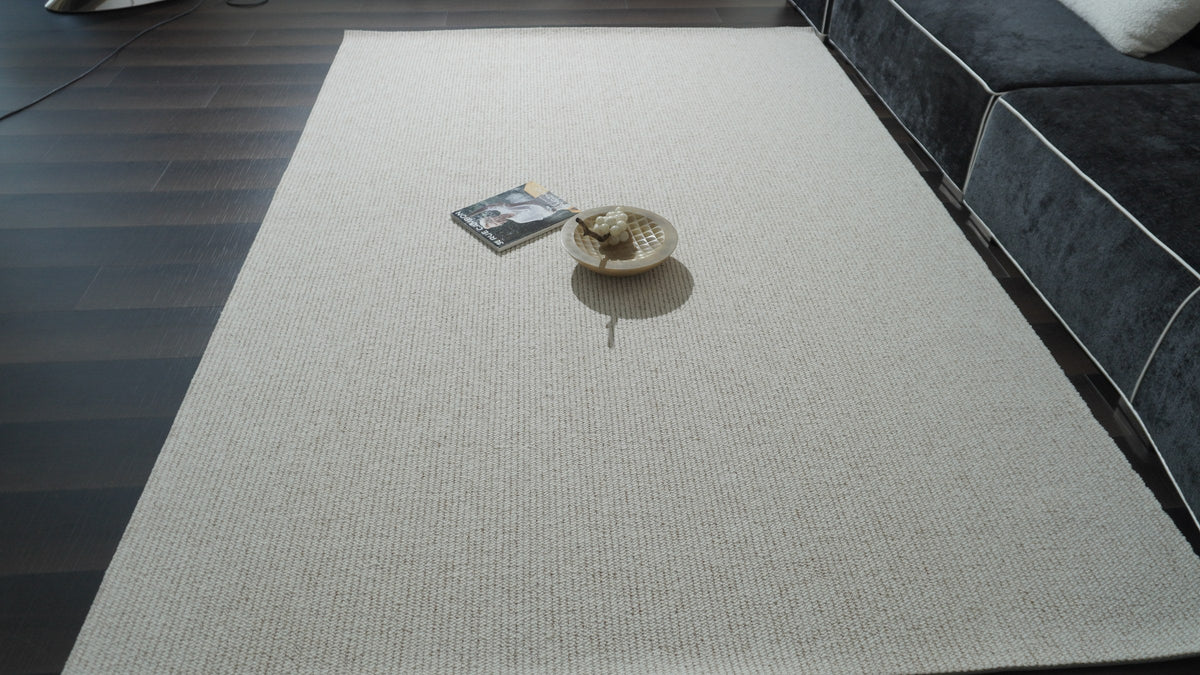
Three weeks after the rug went down, you run a hand along the skirting board and it comes back pale. There is a soft drift of fluff where the dark timber meets the wall, a fuzz across the seat of the charcoal sofa, and a vacuum canister you emptied on Sunday that could be emptied again today.
A 100% wool rug with a cut pile typically sheds noticeably for three to six months, and some hand-tufted rugs keep going for nine. A wool-blend rug with a looped pile, the kind Elmsett makes, usually settles within 2–6 weeks. Neither is a fault. What you are seeing is short fibre left over from spinning and cutting, working its way out of the pile.
This piece covers what a normal settling period looks like for each construction, the signs that mean something is actually wrong, how to get through the fluffy weeks without damaging the rug or the floor, and what to look for if you have not bought yet. It assumes a hard floor and a vacuum whose brush bar you can switch off.
How long does wool rug shedding last?
How long a wool rug sheds depends more on how it was made than on the wool itself. Cut-pile and hand-tufted 100% wool rugs shed for 3–6 months, sometimes longer. Flatweaves shed very little. A wool-blend loop pile settles in weeks rather than months, because it has fewer cut ends and part of its yarn is continuous synthetic filament.
| Construction | Typical noticeable shedding | What settling looks like |
|---|---|---|
| 100% wool, cut pile or hand-tufted | 3–6 months; up to about 9 in thick or high-pile rugs | Heavy in the first month, then tapering. A little fluff may continue for the life of the rug |
| 100% wool flatweave (kilim, dhurrie) | Minimal | Occasional loose fibre, mostly at the edges |
| Wool-blend loop pile (Elmsett) | 2–6 weeks | A lighter canister each week until the vacuum comes up close to clean |
Windows last checked September 2026. The 3–6 month figure for 100% wool is the one most Australian rug retailers publish, and it matches the US retailer Edward Martin, which calls the first three to six months the break-in period. One Australian furniture retailer allows up to about nine months. The 2–6 week figure for a wool-blend pile is Elmsett’s own, from our help page, and it describes our rugs rather than every blend on the market.
“Low-shed” is a description retailers use, and we use it too. It is not an Australian standard, and no body tests for it. Treat it as a claim about construction, then check the construction.
Why the first weeks are the worst
Wool is a staple fibre: short strands spun together into yarn. When that yarn is cut to make a pile, the ends fray a little, and the shortest strands in the twist are held by almost nothing. Thousands of them are sitting in the pile when the rug leaves the factory. Every footstep and every vacuum pass works a few more to the surface. That is the fluff on your skirting board. It is not the rug wearing out; the fibre coming away was never properly anchored in the first place.
Two things shorten the window. A looped pile has no cut ends: the yarn goes down into the backing and comes back up unbroken, so the only loose fibre is what the spinning never caught. And a blended yarn carries nylon, polyester or polypropylene alongside the wool. Those are continuous filaments, not short staple, so there is less short fibre in the yarn to begin with.
Elmsett’s rugs use both. New Zealand wool is blended with synthetic fibre and made up in a looped or pebbled pile, and that is why our figure is weeks rather than months. It is still wool. It still sheds. It just runs out of loose fibre sooner.
Is this normal, or did I buy a bad one?
Normal shedding is light, spread evenly across the rug, and lighter each week. A faulty rug loses fibre in clumps, thins in patches or shows its backing. Elmsett and most Australian rug retailers treat the first kind as a characteristic of wool, not a fault, and the second kind as something to photograph and report.
Normal, keep vacuuming
- Fine fluff on floor and furniture, spread evenly
- The canister fills a little less each week
- An occasional single loop standing proud (snip it level, never pull)
- A trace of fluff for years on a hand-tufted cut pile
Worth a call to the retailer
- Tufts or clumps of yarn coming away in your hand
- Heavy shedding that is not easing past six months on 100% wool, or past two months on a wool blend
- Bald or thin patches, especially where nobody walks
- Backing visible through the pile, or the rug losing its shape
The six-month line and the bald-patch and visible-backing tests are the same ones the larger Australian rug retailers publish, so you should get a consistent answer wherever you bought. If you are in the right-hand column, email the retailer two photos: one of the whole rug, one close up on the problem. At Elmsett that address is hello@elmsett.com. A faulty rug costs you nothing to put right, and we pay the freight in both directions.
Will it ruin dark floors and a dark couch?
No. Rug fluff is loose wool, not dye or oil. It cannot stain a timber finish or a fabric sofa; it sits on top and lifts off. Pale fibre simply shows more against charcoal and dark timber, so the same amount of shedding looks worse in your room than it would in a cream one. The thing that can mark a dark floor is under the rug, not on it: a cheap PVC underlay or rug tape.
The routine for the settling weeks:
- Vacuum with suction only. Switch off the rotating brush or use a flat floor head. A brush bar roughens a looped pile and pulls at fibre that was going to stay put.
- A little more often, not a lot more. Twice a week in the first month suits most rooms, with slow passes. Daily passes on high suction pull out fibre that was not loose yet, and can prolong the shedding rather than end it.
- A lint roller or a damp rubber glove on the sofa. Drag a rubber-palmed glove across the cushions and the fibre rolls into a strip you can pick up. Faster than the upholstery attachment, and kinder to the fabric.
- Skirting boards with a dry microfibre cloth, not the vacuum brush, so you are not blowing fluff back under the rug.
- A felt and natural rubber underlay, cut 5–10 cm in from each edge so it stays hidden. It stops the rug creeping, which is what grinds fibre loose at the edges, and it will not mark a polished timber finish. Skip PVC underlays and rug tape.
- A loop standing up: snip it level with sharp scissors. Please don’t pull it, because pulling draws out more of the yarn.
By week six on a wool blend, there should be almost nothing in the canister. On a 100% wool cut pile, keep the same routine and expect a slow taper over the next few months.
What if you’re choosing a rug now?
If you have not bought yet, and the thought of six months of fluff on a dark floor is the thing holding you back, three choices do most of the work. Pick a blend rather than 100% wool, because the synthetic share of the yarn is continuous filament with no short ends to lose. Pick a loop or a flatweave rather than a cut pile, because uncut yarn has nowhere to fray. And look for a retailer that states a shedding window in weeks or months on its help page, rather than “minimal shedding” with no number attached. A stated window is a claim you can hold them to.
Elmsett’s rugs pass that list, and other rugs do too. Ours are New Zealand wool blended with nylon, polyester or polypropylene in a looped pile, with a 2–6 week settling window we publish, a current size of 200 × 300 cm, and a price of $549 to $649 with delivery included Australia-wide.
Questions people ask about rug shedding
Does vacuuming make shedding worse?
Vacuuming with suction only, once or twice a week, speeds settling by lifting fibre that is already loose. It is the method that does the damage: a rotating brush bar pulls at anchored fibre and roughens a looped pile, and daily high-suction passes can do the same. If your vacuum has no off switch for the brush, use the hard-floor head.
Does humidity matter?
Humidity does not change how much a rug sheds, but it changes where the fibre ends up. Dry air builds static, so fluff clings harder to a dark fabric sofa; a damp cloth or rubber glove works better than a dry brush. In humid rooms the concern is not shedding but damp. Wool holds moisture, and a rug that stays damp can grow mould, so keep it out of laundries and bathrooms and let it dry fully if it gets wet.
Should I return a rug that sheds?
Not for shedding alone. Most Australian rug retailers, Elmsett included, treat normal shedding as a characteristic of wool rather than a fault, and at least one large retailer’s returns policy says so in as many words. An unrolled Elmsett rug that is not faulty can be exchanged within 30 days of delivery, not refunded. Clumps, bald patches or visible backing are a different matter. Those are faults, and a faulty rug is collected and put right at no cost to you.
Week six. You run a hand along the same skirting board and it comes back clean. There is one stray fibre on the arm of the sofa, and the canister after Sunday’s vacuum has a thin grey film at the bottom rather than a nest. The rug has stopped announcing itself. It is just the warm thing your feet find first in the morning.
If you are still in the fluffy weeks, our help page has the care answers in one place: underlay, spills, pulled loops and the rest. If you are choosing, browse the collection; our current rugs are 200 × 300 cm.
Sources
- Elmsett, Help: “Why is my new rug shedding?”, “Do I need an underlay?”, “A loop has pulled loose”, “Can I return a rug if I change my mind?”
- Edward Martin, “Do All Wool Rugs Shed And How Long Does It Last?” (3–6 month break-in period; staple length and anchoring)
- Edward Martin, “Do Polyester Rugs Shed As Much As Wool Rugs?” (staple fibre vs continuous filament)
- Simple Style Co, “Do Wool Rugs Shed? What’s Normal & How to Reduce Shedding” (3–6 months; bald patches and visible backing thresholds; over-vacuuming can worsen shedding)
- Simple Style Co, Returns Policy (shedding treated as a natural characteristic, not a fault)
- King Living, “A Complete Guide to Wool Rugs” (shedding up to about nine months)
- Carpets Wall to Wall, “Carpet Shedding and Fuzzing” (spun staple yarn vs continuous filament; loop pile less prone)