
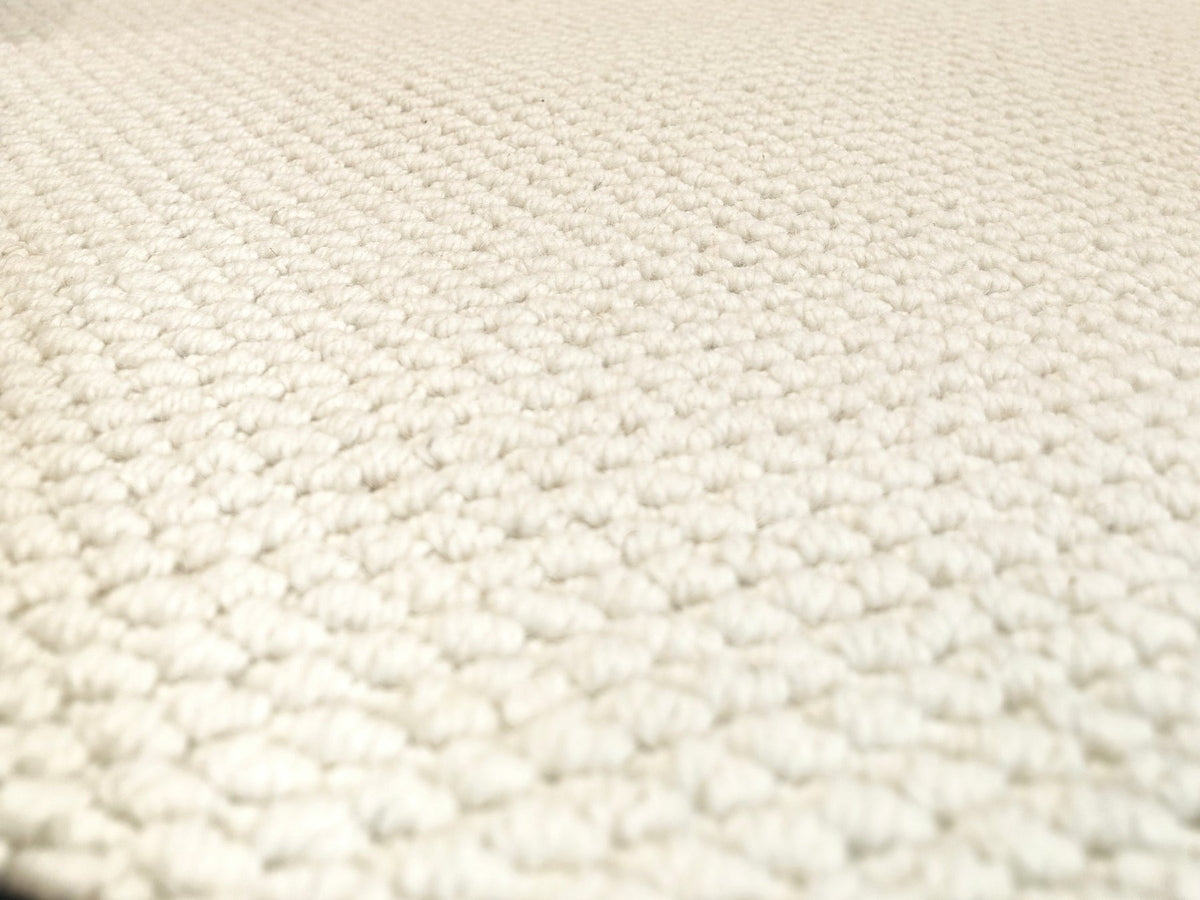
Every soft floor covering collects some dust. What changes from rug to rug is how deep that dust can settle and how easily you can get it out again. A short, close loop pile keeps dust nearer the surface, where a weekly vacuum can reach it. Elmsett blends its wool with synthetic fibres for less shedding, so there is less fluff to chase as well.
This guide explains why pile height matters for dust, what Australian health bodies say about rugs when someone at home has a dust mite allergy, and how to look after a short-pile wool blend rug so it stays easy to live with. It is general information about choosing and caring for a rug, not medical advice.
Why pile height matters for dust
Pile is the yarn that stands up from a rug's backing. In a long or shaggy pile, each strand is long and loosely spaced, so dust, crumbs and pet hair can fall deep between the fibres, down towards the backing. A vacuum has to pull them back up through a lot of yarn.
In a short pile, the yarn is low and close together. There is less depth for dust to sink into, and more of it stays where the vacuum can lift it. Loops add one more advantage: the yarn is not cut at the surface, which removes one source of loose ends, though a loop pile can still release some fibre.
Australian health advice draws the same line. The Victorian Government's Better Health Channel lists shag-pile and long-fibred carpets among the places dust mites hide, and its asthma-friendly home guide suggests avoiding carpet and, if you do choose carpet, a short pile or loop carpet in nylon that is solution dyed. A 1995 study in the Journal of Allergy and Clinical Immunology (Babe and colleagues) found dust mites at very low levels in a US hospital with carpeted rooms and credited low-pile carpet, together with low humidity and good housekeeping.
Those sources are about floor coverings in general, not tests of any particular rug. They still give a clear rule of thumb: the shorter and closer the pile, the less room dust has to hide.
If someone at home has a dust mite allergy
House dust mites are a common trigger for year-round allergies. Healthdirect lists year-round rhinitis among the symptoms, with a runny or blocked nose, sneezing and an itchy nose, along with asthma and a type of eczema. Mites live in soft furnishings, and carpet is one of them.
Here is what the health bodies recommend, plainly stated:
- Hard floors come first. The Australasian Society of Clinical Immunology and Allergy (ASCIA) suggests replacing carpets with hard floors where practical and affordable, because carpets can hold dust mite allergen that vacuuming cannot completely remove.
- If you have soft flooring, keep the pile short. Better Health suggests avoiding carpet and, if you choose it, short pile or loop; it lists shag-pile and long-fibred carpets among the places mites hide.
- Vacuum weekly, ideally with a HEPA filter. The National Asthma Council Australia recommends weekly vacuuming of carpets and soft furnishings with a HEPA vacuum if possible.
- Let someone else vacuum. Vacuuming stirs allergen into the air for up to 20 minutes, even with a HEPA filter, so the National Asthma Council suggests the person with allergies leaves the room while it is done, and ASCIA suggests waiting 20 minutes before going back in.
- Rugs and mats are on the list too. Better Health suggests removing carpets, rugs and mats where practical, and washing rugs and mats regularly. An Elmsett rug can't go in a washing machine, so plan on professional cleaning instead.
Many Australian homes already have timber, tile or concrete floors. A rug on a hard floor sits between the two options: it softens one area of the room, covers far less floor than wall-to-wall carpet, and can be lifted, rolled and professionally cleaned. If you want a rug in that situation, a short pile you can vacuum thoroughly is the more practical choice than a deep shag.
To be clear about the limits: no rug removes dust mites, and we can't promise any rug suits every allergy. Better Health notes that research on reducing household dust has had inconsistent findings, with most finding a small reduction in asthma symptoms. For advice that fits your household, talk to your GP or an allergy specialist.
Is wool itself an allergen?
Wool is often blamed for allergies, but the evidence points elsewhere. A 2017 review in Acta Dermato-Venereologica (Zallmann and colleagues) looked at a century of research and concluded that current evidence does not suggest wool fibre is a skin allergen. The prickle some people feel from wool clothing comes from coarse fibres pressing on the skin, which is irritation rather than allergy.
That review was about clothing worn against the skin, so it does not make any rug allergy-safe. It does mean wool content alone is not a reason to rule out a wool blend rug. Dust mites are the more relevant question for a floor covering, and pile height and regular cleaning are where health guidance focuses.
Less fluff: what the blend adds
All new wool rugs release some loose fibre at first. Short fibres left in the yarn after manufacture work their way to the surface with walking and vacuuming. You notice it as fluff, especially on dark timber.
Each Elmsett rug blends New Zealand wool with synthetic fibres, named on its product page, for less shedding and everyday durability. Textile research is consistent with the durability part: a review published by IntechOpen reports that blending nylon or polyester with wool can increase abrasion resistance, a general textile finding rather than a test of our rugs. Our loop construction helps too, because uncut loops remove one source of exposed yarn ends.
It is worth being exact about what that means. A blend helps manage shedding; it does not make a rug shed-free, and fibre content alone does not predict how much a rug will shed. Expect some fluff in the first 2–6 weeks, which settles with regular vacuuming. Our low-shed wool rug guide and shedding timeline go into the detail.
Short pile and long pile at a glance
| Short loop pile | Long pile or shag | |
|---|---|---|
| Where dust settles | Nearer the surface | Deep between long strands |
| Weekly vacuuming | Reaches most of the pile | Struggles to reach the base |
| Health-body guidance | If carpet is chosen: short pile or loop (Better Health also suggests nylon, solution dyed) | Shag and long-fibred carpets are listed among mite hiding places |
| Yarn at the surface | Loops stay uncut | Usually cut, with exposed yarn ends |
| Feel underfoot | Firm, textured, even | Deep and plush |
The table combines the sources above with general observations about pile types. It is not a set of laboratory measurements of particular rugs.
A care routine to keep dust down

- Vacuum once a week, with suction only. Switch off rotating brushes, which can roughen loops. Use slow passes so the suction has time to lift dirt from between the loops. A HEPA-filter vacuum is worth using if anyone at home has allergies.
- Vacuum a little more often in the first 2–6 weeks. This collects early loose fibres and helps them settle sooner.
- Have someone else vacuum if a person at home has a dust mite allergy, and keep them out of the room for about 20 minutes afterwards.
- Keep the room dry and aired. Dust mites thrive in warm, humid conditions. Good ventilation helps, and a rug should never stay damp.
- Rotate the rug every few months so wear and light fall evenly.
- Book a professional clean every 12–18 months with a rug cleaner experienced with wool. Don't use a washing machine or a home steam cleaner on an Elmsett rug.
- Snip, don't pull, a raised loop. Trim it level with the surrounding pile using sharp scissors.
Our wool blend rug care guide covers spills and deep cleaning in more detail.
Questions about short‑pile rugs and dust
Are short‑pile rugs better for allergies?
Health bodies suggest hard floors first; where carpet is chosen, Better Health suggests short pile or loop over shag. A short pile is easier to vacuum, but no rug can promise to help allergy symptoms, so ask your GP or allergy specialist what fits your home.
Does a wool blend rug collect less dust than a shaggy rug?
A short, close pile gives dust less depth to settle into than a long, loose pile, so more of it stays where a vacuum can reach. Every soft floor covering still collects some dust, which is why weekly vacuuming matters.
Is wool bad for people with sensitive skin?
A 2017 review found that current evidence does not suggest wool fibre is a skin allergen. Some people feel a prickle from coarse wool, which is irritation rather than allergy. If you have a known reaction to wool, follow your doctor's advice.
Do wool blend rugs shed less than pure wool?
They can. Elmsett blends its wool with synthetic fibres for less shedding and everyday durability, and our loops remove one source of cut ends at the surface. Every new wool rug still sheds some loose fibre for the first few weeks, so compare the actual rugs rather than relying on the label alone.
How often should I vacuum a short‑pile rug?
Once a week for most rooms, with suction only, and a little more often in the first 2–6 weeks. If anyone at home has allergies, a HEPA-filter vacuum is worth using.
Can I put a wool blend rug in the washing machine?
Not an Elmsett rug. Use a rug professional experienced with wool every 12–18 months, and avoid washing machines and home steam cleaners.
Choosing your rug
Start with the room and the routine you can keep. If dust is a concern at home, look for a short, close pile you can vacuum thoroughly, and plan for a weekly vacuum. Every Elmsett rug has a tufted loop pile in a New Zealand Wool Blend; Halcyon's close, even loops and Daybreak's close, flecked surface are good places to start, and each product page shows the texture up close. Measure your space with the size guide, then explore the rugs.
Sources
- Better Health Channel: House dust mite, Victorian Government, last reviewed 14 July 2022: shag-pile and long-fibred carpets among mite hiding places; remove carpets, rugs and mats where practical; bare floors preferred.
- Better Health Channel: Asthma-friendly home, last reviewed 17 November 2022: avoid carpets, and if choosing carpet, short pile or loop, nylon and solution dyed; inconsistent research findings on dust reduction.
- ASCIA: Allergen minimisation (information for patients and carers), content updated April 2024: hard floors where practical; carpets hold allergen vacuuming cannot completely remove; wait 20 minutes after vacuuming.
- National Asthma Council Australia: Dust mites trigger my asthma and allergies: weekly HEPA vacuuming; allergen airborne for up to 20 minutes after vacuuming.
- Healthdirect: Dust mites, last reviewed March 2025: year-round rhinitis, asthma and eczema symptoms.
- Babe KS Jr, Arlian LG, Confer PD, Kim R. House dust mite prevalence in the rooms and hallways of a tertiary care hospital. J Allergy Clin Immunol 1995;95(4):801–5.
- Zallmann M, Smith PK, Tang MLK, Spelman LJ, Cahill JL, Wortmann G, Katelaris CH, Allen KJ, Su JC. Debunking the myth of wool allergy. Acta Derm Venereol 2017;97(8):906–15.
- Özdil N, Kayseri GÖ, Mengüç GS. Analysis of Abrasion Characteristics in Textiles. IntechOpen, 2012.
- Elmsett Help and product pages: our current material and care guidance, checked 7 October 2026. Elmsett sells wool blend rugs; this is our own guide.