
The test is simple. Pull every chair back as if someone were getting up, and check that the chair legs stay on the rug. Find your fit puts a number on it: chairs need about 60 cm to pull back. So a rug under a dining table should reach about 60 cm past the table on every side where a chair sits.
On a 200 × 300 cm rug, that leaves room for a table up to 80 cm wide and 180 cm long with chairs on all four sides: 80 cm plus 60 cm on either side makes 200 cm, and 180 cm plus 60 cm at each end makes 300 cm. Larger tables use up some of that margin, so this guide works through the tables Find your fit draws, how to measure your own, and what changes with a round table.
How much rug does a dining chair need?
A dining chair needs floor in two places: where it sits while someone eats, and where it lands when they stand up. Find your fit draws its chairs 45 cm wide and 50 cm deep, in the seated position at the table, and allows about 60 cm for pulling one back.
The number that matters for the rug is how far a chair’s back legs travel from the table’s edge when it is pulled out. If the rug stops short of that, the back legs leave the rug each time someone stands, which is what the size guide’s test is there to catch.
Your table on a 200 × 300 cm rug
These are the tables Find your fit draws, each with a 200 × 300 cm rug laid under it, the rug’s long side along the table’s long side. The figures are how far the rug reaches past the table’s edges. Compare each one with the 60 cm a chair needs.
| Table | Rug past the ends | Rug past the sides |
|---|---|---|
| Four seats, 120 × 80 cm | 90 cm | 60 cm |
| Six seats, 180 × 90 cm | 60 cm | 55 cm |
| Eight seats, 220 × 100 cm | 40 cm | 50 cm |
| Round, four seats, 100 cm across | 100 cm | 50 cm |
| Round, six seats, 130 cm across | 85 cm | 35 cm |
For a round table, the ends are towards the rug’s short edges and the sides towards its long edges.
A four-seat table sits comfortably, with 60 cm or more on every side.
A six-seat table is the closest call. The ends have the full 60 cm, but the long sides have 55 cm, 5 cm short of the 60 cm a chair needs to pull back. Find your fit’s six-seat drawing seats two along each long side and one at each end, so four of the six chairs are on those long sides. Whether 55 cm is enough depends on how far your own chairs travel.
An eight-seat table leaves 40 cm of rug at the ends and 50 cm at the sides. With chairs that need the full 60 cm, the back legs of a chair pulled right back reach 10–20 cm beyond the rug’s edge.
Round tables leave plenty of rug at the ends and less at the sides: 50 cm for a four-seat round table 100 cm across, and 35 cm for a six-seat round table 130 cm across. On a round table, the chairs at the sides run out of rug first.
Measure your own table and chairs
The right fit depends on your table and chairs, so measure them together. It takes a tape measure, a roll of masking tape and a few minutes.
- Measure the table top: its length and width, or its diameter if it is round.
- Measure the pull-back. Sit in one of your chairs, then stand up as if leaving the table, pushing the chair back the way you usually would. Measure from the table’s edge to the back of the chair’s back legs.
- Add it twice. Add that distance to both ends of the table’s length and to both sides of its width. If the totals come to 300 cm and 200 cm or less, the chairs stay on the rug.
- Allow for the finished size. Each rug may vary by up to ±2% on each side: up to 4 cm across the width and 6 cm along the length. If a total comes within a few centimetres of 200 or 300, allow for that.
- Tape it out. Mark out a 2 m × 3 m rectangle on the floor with masking tape, centred under the table. Pull every chair back as if someone were getting up, and check that the chair legs stay inside the tape.
- Or let Find your fit draw it. On any rug’s page, open Find your fit and choose Dining, then Rectangular or Round, then Custom, and type your table’s length and width, or its diameter. It tells you how far the rug reaches past the table’s ends and sides.
Your own chairs are the real test, which is why the size guide asks you to measure them together with the table.
Living with a rug under the table
Under a table, a rug meets chair legs at every meal and the odd spill. A few habits keep it settled.
- An underlay on a hard floor. It stops the rug moving, protects the backing and the floor, and makes the rug feel better underfoot. Choose one about 5–10 cm in from each edge, so it stays hidden.
- Something under the table legs. Furniture presses the pile down over time. Furniture coasters or wide leg cups spread the weight, and to lift a dent you can tease the pile upright with your fingertips.
- Turn the rug now and then. Rotating it every few months lets light and wear fall evenly, and lets pressed areas recover.
- Blot spills straight away. Scoop up anything solid, then blot with a clean white cloth, working from the outside in. Never rub: it spreads the stain and can distort the pile.
- Snip a pulled loop, never pull it. If a loop does pull, trim it level with the pile with sharp scissors; pulling can draw out more of the yarn.
Flattening under furniture is normal wear rather than a fault, which is one more reason to give the table legs something to stand on. Our guide to cleaning a wool blend rug has the rest of the care routine.
Which rug under a dining table
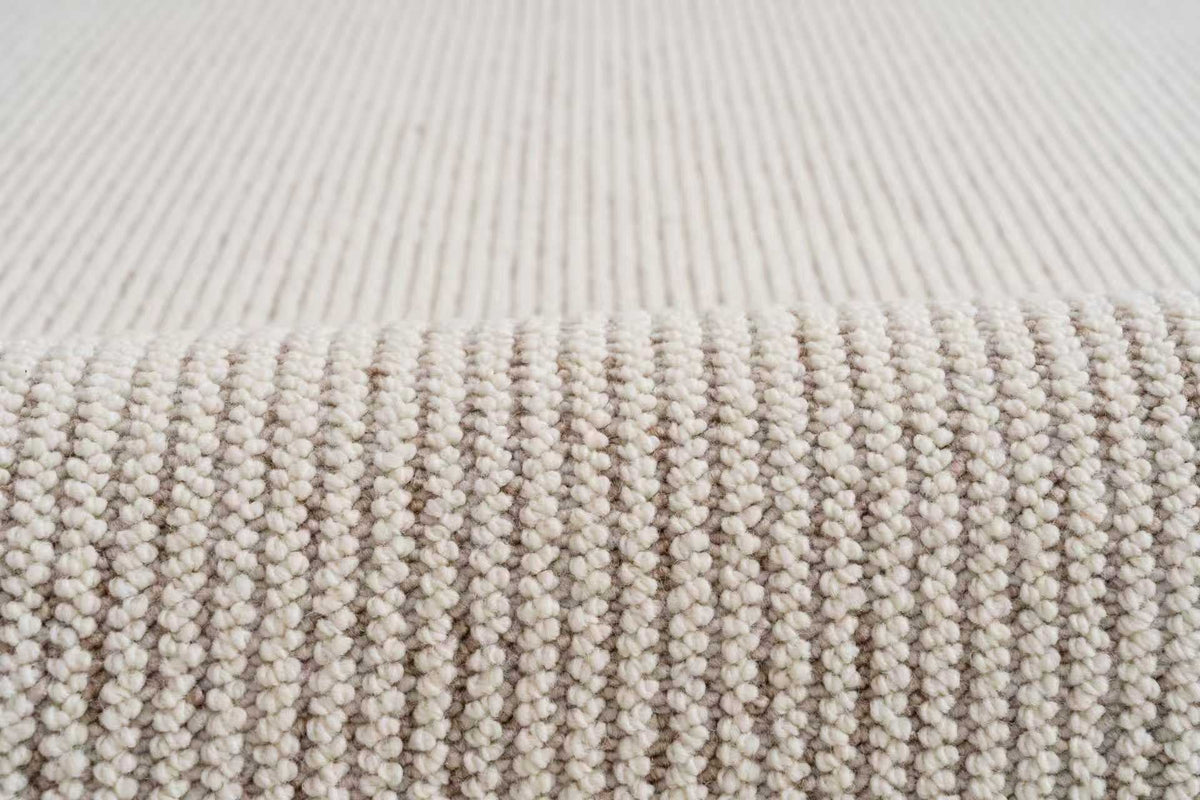
Our current rugs are 200 × 300 cm, so the figures above hold for each of them. Their textures differ: rounded loops in a close, even pattern on Halcyon, a corded surface in cream and taupe on Vesper and in ivory and soft gold on Glint, and finely textured, flecked or chunky surfaces on Sunlit, Daybreak and Dapple. Vesper’s page includes a photograph of it under a white pedestal table.
You can compare them side by side among our textured rugs.
Questions about dining room rugs
Will a 200 × 300 cm rug fit under a six-seat table?
At the ends, yes, and very nearly at the sides. Under Find your fit’s six-seat table, 180 × 90 cm, the rug reaches 60 cm past the ends and 55 cm past the sides, against the 60 cm a chair needs to pull back. If your chairs travel 55 cm or less from the table’s edge, they stay on the rug.
What about an eight-seat table?
A table 220 × 100 cm leaves 40 cm of rug past its ends and 50 cm past its sides, short of the 60 cm a chair needs on every side, so chairs that need the full 60 cm will reach past the rug’s edge when pulled right back.
Can I return the rug if the chairs do not fit?
Tape it out before the rug arrives, and decide before you unroll it. A rug that is still rolled and never opened can come back for a refund of what you paid, less the return collection fee, if you email hello@elmsett.com within 30 days of delivery. An unrolled rug that is not faulty can be swapped for a different rug instead. Our Returns policy has the details, and our guide to living room rug size covers the sofa side of the room.
Sources
- Elmsett, Find your fit, and the Find your fit drawing on each rug’s page (table and chair sizes, and the 60 cm a chair needs to pull back)
- Elmsett, Help: “What size are the rugs?”, “Do I need an underlay?”, “How do I lift dents left by furniture?”, “What should I do if I spill something?”, “A loop has pulled loose. What should I do?”, “Will my rug fade in the sun?”
- Elmsett, Returns policy