
The photographer arrives at 9. The open home is Saturday. You unrolled the rug last night so the creases would drop, and this morning there is a halo of cream fibre across the blackbutt around its edge. You run the vacuum over the floor, the first flash fires, and the cut pile shows every footprint the styling crew left carrying the sofa in. The photographer shoots around it. You know how that frame will look at 1,200 pixels wide on a listing portal.
Most of what goes wrong with a rug on camera is decided before the shoot: the colour, the surface, the sheen, the size, and how long the rug has been out of its wrap. At Elmsett we make wool-blend rugs, and photographing them for our own pages has shown us how each of those five things helps or hurts a frame. This guide is for stylists and stagers choosing a rug that has to survive three lighting conditions, a crew, an open home and then the next campaign. It covers colour, pile, sheen, size, shedding and reuse, and ends with a checklist you can keep on your phone.
What rugs do Australian home stagers recommend for listing photos?
For listing photos, stagers favour large, matte, tonally varied warm neutrals in a loop or low pile, sized to anchor the furniture rather than float between it. Greige, oatmeal and warm cream in a wool or wool-blend loop photograph consistently across daylight, warm LEDs and twilight, hide marks as texture, and do not mirror the flash. A 200 × 300 cm rug with the front legs of the sofa and chairs on it is the usual living-room standard.
The rest of this guide is the reasoning behind that sentence, and where it goes wrong in practice.
Staging itself is worth doing. The National Association of Realtors’ 2025 Profile of Home Staging found 83% of buyers’ agents said staging makes it easier for buyers to picture a property as their future home, and 17% said it lifted the dollar value offered by 1–5% (NAR consumer guide; NAR release, May 2025). Australian property and staging websites often quote two local figures, a 6–20% price uplift attributed to the REIQ and 73% less time on market attributed to the REIA. We could not trace either to a published REIQ or REIA report, so treat them as industry figures, not ours.
How does rug colour behave under different lighting?
A listing shoot runs the same rug through three kinds of light, sometimes in one morning. Daylight through the windows is cool, roughly 5,000–6,500 K, and most real estate photographers bracket exposures and merge them (HDR), which pushes highlights hard. Downlights and lamps are warm, 2,700–3,000 K, and the camera’s white balance has to pick a side. The twilight exterior-to-interior shot mixes both, with a blue sky outside and orange glow inside. A rug colour that holds across all three is the one you want.
What the three warm neutrals do:
- Greige is the safest. It has enough grey to stay calm under warm bulbs and enough warmth to avoid going blue in daylight. On a warm timber floor like blackbutt or spotted gum it separates cleanly from the boards without fighting them.
- Warm cream lifts a dim room and looks light, not white. It needs texture or flecking to avoid looking like a flat pale rectangle in the HDR merge.
- Sand and oatmeal sit closest to Australian timber floors. They look rich under warm LEDs and can disappear against pale oak in flat daylight, so they want a darker floor or a rug with cream in it.
And the avoid-list, which matters more:
- Stark white blows out. HDR merging treats it as a highlight and you lose the texture entirely.
- Cool grey goes blue under daylight white balance, and a blue rug on honey timber looks like a mistake in the listing.
- Yellow-beige goes orange under 2,700 K downlights. In the twilight shot it can read as the same colour as the floor.
| Finish | Daylight, HDR merge | Warm LEDs, 2,700–3,000 K | Twilight, mixed light |
|---|---|---|---|
| Greige loop | Holds its tone, texture reads | Warms slightly, still neutral | Separates from both floor and glow |
| Warm cream loop with flecks | Light but not blown, flecks give depth | Warm and inviting | Lifts a dark corner |
| Plain warm cream, cut pile | Risks going flat and pale | Shows footprints as shading | Shows every mark |
| Sand or oatmeal loop | Can merge with pale oak | Rich, looks expensive | Good against dark timber |
| Cool grey | Goes blue | Goes muddy | Clashes with the warm interior glow |
| Viscose or art silk, any colour | Hot spots at the window | Mirrors the downlights | Flares in the flash |
The thread through that table is tonal variation. A surface with two or three close tones in it reads as texture on camera. A single flat colour looks like a surface waiting to show a mark.
Loop or cut pile for photographs?
Loop, and it is not close. A cut pile has fibres that lean, so every footprint, vacuum stroke and sofa leg leaves a patch where the pile faces a different direction and reflects light differently. The camera sees that as shading. Under flash it looks like someone walked across the frame, because someone did. A loop pile has no direction to crush; the loops compress and spring back, and the surface photographs the same from either end of the room.
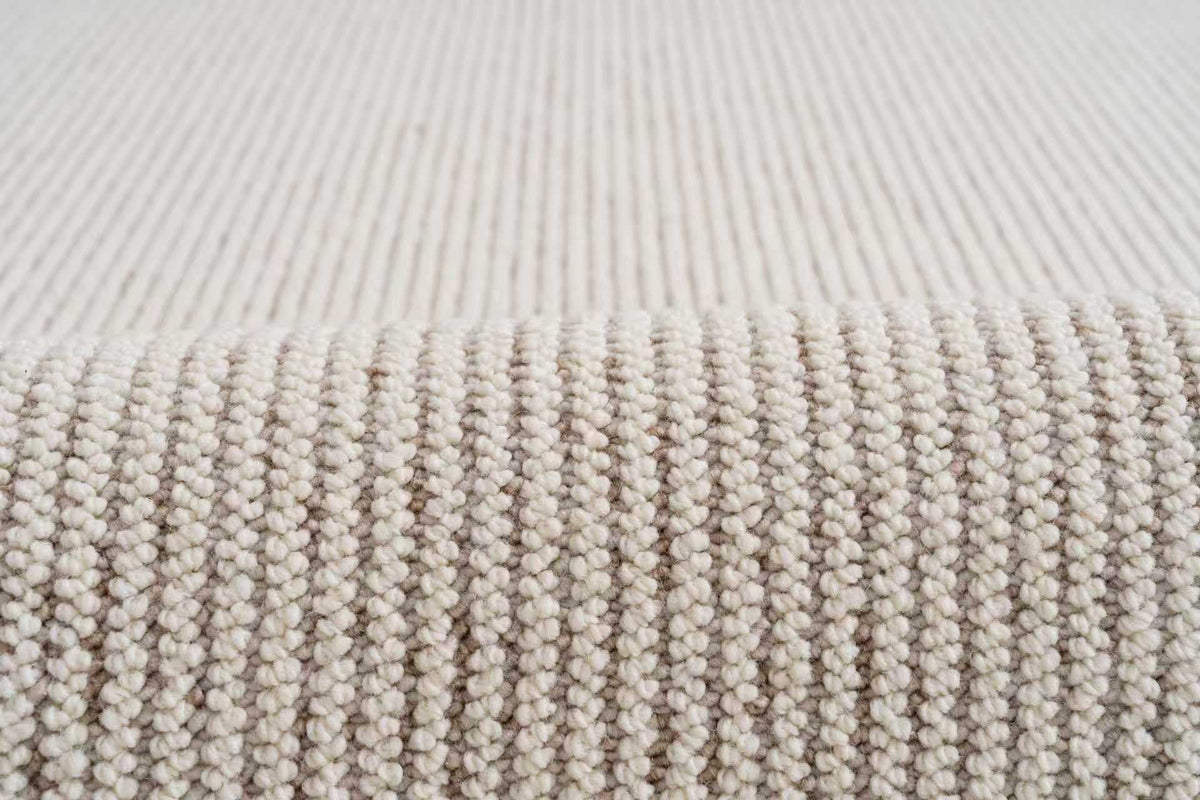
Pile height matters almost as much as construction. Keep the whole surface under about 15 mm. A loop of roughly 8–12 mm gives you shadow between the loops without enough height to show tracking, and shadow is where a photograph gets its depth. A pebbled or corded loop takes this further: the raised rows catch light on one side and hold a sliver of shadow on the other, so the rug has visible texture in a flat, evenly lit HDR frame that would otherwise flatten it.
Two of ours show the difference in texture scale. Glint ($549) runs even rows of ivory loops through a warm, soft-gold ground, and under raking light from a side window each cord throws a line of shadow. Those lines are the rug’s structure in a photograph. Dapple ($649) goes the other way: full cream loops gathered around flecks of warm sand and taupe, with small pockets of shadow between the clusters. In a tall-windowed room with light pouring down, those pockets are what stop the rug reading as a pale blur.
Flatweave is the other option stagers reach for. It photographs clean and lies flat, and it has none of the problems above. It also has none of the depth. In a room with a linen sofa and a timber coffee table, a flatweave can make the floor the flattest surface in the frame. Use it in small rooms and hallways where you need the floor to recede, and use a loop where the rug is doing the anchoring.
Why does sheen matter on camera?
Skip viscose for staging, full stop. Viscose, bamboo silk, art silk and high-lustre synthetics are prized for sheen, and sheen is exactly what a flash, a downlight or a west-facing window turns into a hot spot. The same rug looks silver from one end of the room and dark from the other, so the two angles the photographer shoots will not match. Viscose also water-marks and crushes, and a crushed patch on a lustrous fibre is a permanent bright-and-dark smear.
Matte wool scatters light. The fibre’s scaled surface sends light off in every direction instead of back at the lens, so the rug looks the same tone from the doorway and from the window. A wool blend with nylon, polyester or polypropylene keeps that matte scatter as long as the synthetic is a matte yarn.
One caveat about our range. Sunlit ($649) has sandy golden threads through its ivory loops that carry a gentle sheen, far short of viscose but more than our other rugs. Use it where a room needs lifting and the main light is soft, and choose Glint, Vesper ($549) or Dapple for a room with a hard west window or a photographer who leans on flash.
What size rug reads properly in a listing shot?
For the standard sofa-and-two-chairs living room, 200 × 300 cm is the size that lets the front legs of every seat sit on the rug with floor still showing around the outside. A rug that stops short of the sofa legs photographs as a mat in the middle of the room, and the wide-angle lens most listing shots use exaggerates the gap.
Two placement rules carry most of the result. Put the front legs of the sofa and the occasional chairs on the rug so the seating holds together as one group. Then leave a band of floor around the rug so the boards frame it; that band is where the open-home traffic goes, and it earns its keep on Saturday. Our size guide has the masking-tape method for checking a room before the rug arrives: tape out 2 m × 3 m on the floor, open the doors, walk the path a buyer will.
A rug this size wants an underlay on hard floors, cut about 5–10 cm in from each edge so it stays hidden. Felt and natural rubber suit timber; cheap PVC can mark some floor finishes and rug tape can leave residue. Neither is a conversation you want with a vendor.
How do you stop a new rug shedding before the shoot?
Unroll the rug 48 hours before the photographer arrives, vacuum it with suction only on each of the two evenings before, and start from a low-shed wool blend so there is less fibre to lift in the first place. Shedding cannot be switched off in a new rug with wool in it, but it can be got ahead of.
A new wool-blend rug sheds loose fibres for the first 2–6 weeks. Staging rugs are almost always new, and almost always photographed inside that window. Plan for it or the floor around the rug will show it.
Shedding is not a fault, it is the loose short fibres left over from spinning and tufting working their way out of the pile. Pure wool and jute shed the most and for longest; a hand-knotted wool or jute piece can leave fibre on a floor for months. A wool blend sheds less because the synthetic fibres are continuous filaments and the blend holds the wool in place. That is why each of our rugs carries nylon, polyester or polypropylene alongside the wool. The settling period is shorter, not zero. Never trust a “shed-free” claim on a rug with wool in it.
The routine we would use for a rug that has to photograph on a Saturday:
- Thursday morning, unroll it face up in the room it will be shot in, and weight the corners with books or the coffee table. Roll creases and curled edges relax in the first 1–2 weeks; 48 hours is usually enough to get the corners down for a photograph.
- Thursday evening, vacuum with suction only. Slow passes, no rotating brush. A brush bar roughens a loop pile and pulls more fibre out, the opposite of what you are there to do.
- Friday evening, vacuum again, the rug and then the floor around it. Then stop walking on it.
- Saturday, 30 minutes before the photographer, check the four corners, lint-roll the band of floor around the rug, and look along the surface from floor level against the window. That raking view shows fibre and dents the camera will see.
- If a loop has pulled, snip it level with scissors. Pulling it draws out more yarn.
- If a furniture leg has left a dent, tease the pile up with your fingertips. For a stubborn one, let an ice cube melt on the spot, blot, and brush the pile up again.
A rug that has done one campaign already is easier: it has shed most of what it will shed and its creases drop out faster. That is an argument for building a kit rather than buying per listing.
Which rugs survive ten listings?
A matte wool-blend loop in a tonal neutral. It compresses and recovers, hides the odd mark as texture, rolls without lasting creases, and does not water-mark from a wet shoe. Jute looks the part in a coastal listing but marks when damp, sheds for months and frays at the roll. Viscose is finished after the first crushed corner. Plain cut pile shows a traffic lane by the third open home. Washable synthetics survive. They also photograph flat and slightly glossy, and that is the trade.
Some logistics, because they decide what a rug costs you per campaign. A 200 × 300 cm rug rolled and wrapped is about 2.06 m long and around 20 kg, so it is a two-person lift into a van and will not fit a hatchback. Roll it, never fold it, and keep the original wrap for transport between homes. Store it rolled on its side, not standing on one end, or the end crushes.
Once one of ours has been unrolled it cannot be returned for a refund unless it is faulty; it can be exchanged within 30 days of delivery for the collection fee and any difference in price, but no retailer we know of sells an unrolled rug as new. Buy for the kit, not for the listing. At $549–$649 with free delivery Australia-wide and no regional surcharge, one of ours works out at under $65 a campaign across ten listings. That is the maths a stylist actually runs.
For a kit of two, choose a warm mid-tone and a flecked cream so one of them suits every floor you meet. Glint and Dapple is the obvious pairing; Daybreak ($649), with oatmeal flecks through ivory loops, is the quieter alternative to Dapple, and Halcyon ($549) is the one to pick when the brief is plain cream and the floor is dark.
What should be on the stager’s rug checklist?
- Greige, warm cream or sand, with at least two tones in the surface
- Loop or pebbled pile under 15 mm, never shag, never plain cut pile
- Matte fibre; no viscose, bamboo silk or art silk anywhere in the blend
- 200 × 300 cm for a sofa and two chairs, front legs on the rug
- Floor visible around all four sides
- Underlay 5–10 cm in from each edge, felt or natural rubber
- Unrolled face up 48 hours before the shoot, corners weighted
- Vacuumed with suction only, twice, the second time the night before
- Corners, edges and the floor band checked at floor level against the window
- Rolled, never folded, in its wrap between campaigns
Frequently asked questions
Is a cream rug too risky for open homes?
Not if it is a textured cream and it is placed properly. A flecked or pebbled cream loop hides a mark as part of its surface where a plain cream cut pile shows it as a stain. With the front legs on the rug and a band of floor around it, buyers walk on the boards, not the rug. A plain cream cut pile at an open home is a risk; a cream loop with sand or oatmeal flecks is a staging staple.
Loop or flatweave for listing photos?
Loop for the room the rug is anchoring, flatweave where the floor should recede. A flatweave lies dead flat and photographs clean, but it gives the camera nothing to catch, so a living room with linen and timber can look like it has a printed floor. A loop of 8–12 mm holds shadow between the loops and keeps its texture in a flat HDR frame.
What pile height photographs best?
Under about 15 mm, and ideally a loop around 8–12 mm. Anything taller shows tracking from feet and furniture under flash, and a shag looks dated on a listing portal. Flatweaves at a few millimetres photograph clean but flat.
How far ahead should I order a rug for a shoot?
A week, and two if you can, or for Perth and Hobart. Once it leaves our Sydney warehouse, delivery is an estimated 1–3 business days to Sydney, Canberra, Melbourne, Brisbane, the Gold Coast, Newcastle and Wollongong, 2–4 to Adelaide, and 4–7 to Perth and Hobart. You then want 48 hours unrolled before the photographer arrives. Shedding settles over 2–6 weeks, so a rug that has done one campaign already will shed less at its second.
Can I return a rug after one campaign?
No. Once a rug has been unrolled it cannot be sold as new, so Elmsett does not refund it unless it is faulty, and a rug that has been through an open home is not refundable anywhere we know of. We exchange an unrolled, unused rug within 30 days of delivery for a different style; you pay the collection fee and any difference in price. Treat a staging rug as kit, choose it for the floors you meet most, and expect it to earn its price over ten listings rather than one.
Saturday, 8.30. The rug has been down since Thursday, vacuumed twice, corners flat. You lint-roll the band of blackbutt around it, crouch at the window end and look along the surface. Nothing. The photographer arrives at 9, fires the first flash, and the only shadow on the rug is the one the cords are supposed to make.
The rugs we make for rooms like that are at elmsett.com
Sources
- National Association of Realtors, Consumer Guide: Staging Your House for a Sale (2025 Profile of Home Staging, 83% figure)
- NAR press release, 6 May 2025 (17% of buyers’ agents, 1–5% uplift)
- REIQ and REIA figures as circulated on Australian property and staging sites, not traced to a primary report (one of them credits the 73% to the US Real Estate Staging Association): conveyancingsydney.net and sellinstyle.com.au
- Elmsett Help (shedding, vacuuming, underlay, delivery, returns, rolled dimensions)
- Elmsett size guide (front-legs rule, masking-tape method)