
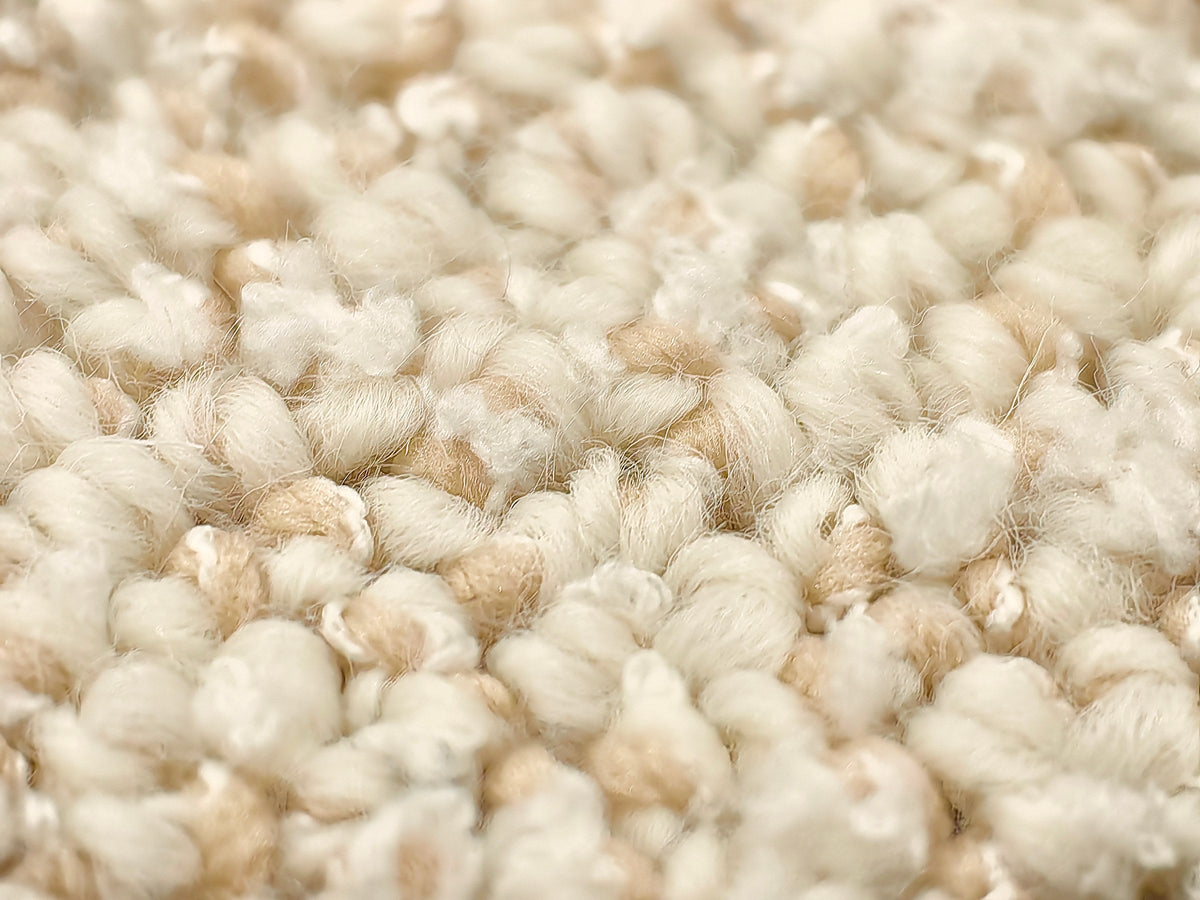
Two tabs are open. One has an A$300 synthetic rug; the other, an A$600 wool blend. Both are 200 × 300 cm. The new floorboards go in next month, and you would like to buy once and get on with living in the room.
The short answer: an A$600 wool blend can be worth the extra A$300, but it is not automatically cheaper per year. With assumed lives of five years for the synthetic and ten for the blend, both cost A$60 a year in purchase costs. The blend becomes cheaper only if it lasts more than twice as long, before differences in cleaning and other costs. If you value its particular feel and texture, it can still be worth choosing when the arithmetic ties.
Three rugs, the same living room
For this worked example, keep the size at 200 × 300 cm: six square metres under the same sofa, coffee table and everyday foot traffic. Change the material and purchase budget, not the room.
- A$300 synthetic: our illustrative lower-price option. Synthetic is a broad category: polypropylene, polyester and nylon do not all behave alike.
- A$600 wool blend: our illustrative middle-price option. Elmsett's 200 × 300 cm wool blend product listings checked on 2 October 2026 were A$549–649. A$600 is a rounded example, not the price of a named rug.
- A$1,200–2,000 pure wool: a higher-budget scenario for context. These are assumed purchase budgets, not a surveyed Australian market range or an Elmsett offer. For rugs described as 100% wool, check whether that description refers to the pile rather than the backing too.
There are cheaper synthetics than the A$300 example: a large-retailer Australian listing shows a 200 × 300 cm synthetic at about A$250. That makes the honest comparison tougher for the blend, not easier. We show what that changes below. Delivery charges and availability should be checked at purchase.
What lifespan assumptions are fair?
Use a conservative budgeting approach: do not make the premium rug win by assuming a very short life for the cheaper one and several decades for the expensive one. Our starting assumptions are five years for the synthetic, ten for the blend and fifteen for the pure-wool example. These are assumed useful lives for arithmetic, not measured averages, guarantees or evidence that an Elmsett rug will last ten years.
Here, useful life means the time you actually keep using the rug in a condition you find acceptable. Construction, pile, traffic, cleaning, pets, sunlight and your willingness to keep a worn rug all matter. A material label alone cannot tell you that number. Nor does moving house necessarily end its life: you may take it with you.
We do not turn lifetime claims about handmade heirlooms or fitted carpet into a forecast for a living-room area rug. The International Wool Textile Organisation's 2025 report compares tested wool and wool/nylon Axminster carpets; it does not establish the calendar lifespan of the rugs in this example. Rather than pretend the missing blend-lifespan data exists, we vary the assumptions openly.
Purchase cost per year: the worked table
Formula: purchase price ÷ assumed years of use = purchase cost per year. All amounts below are Australian dollars. This first table excludes cleaning, delivery, underlay, repairs and disposal; it is not total ownership cost.
| Example rug, 200 × 300 cm | Assumed purchase price | Assumed useful life | Purchase cost per year |
|---|---|---|---|
| Synthetic | A$300 | 5 years | A$60 |
| Wool blend | A$600 | 10 years | A$60 |
| Pure wool, context only | A$1,200 | 15 years | A$80 |
| Pure wool, higher budget | A$2,000 | 15 years | A$133.33 |
Last verified: 2 October 2026. Prices in this table are scenario inputs; all lifespans are assumptions. Results are calculated, not observed product performance. External evidence and Elmsett policy sources are linked in the relevant sections.
An A$600 wool blend needs more than twice the useful life of an A$300 synthetic to win on purchase cost per year; at twice the life, they tie.
Now give both rugs the same ten-year calendar window. If the A$300 synthetic needs replacing after five years, you buy two for a total of A$600. If the A$600 blend serves the whole ten years, you buy one for A$600. The purchase spending is equal. This assumes unchanged replacement prices, no resale value and no early damage; it ignores inflation and the time value of money. Paying A$300 now also leaves A$300 available for other things today.
When the answer changes
The following are alternative assumed outcomes, not predictions or probabilities. They show why “usually cheaper” would be too strong a conclusion.
| Scenario | Synthetic: assumed life and annual purchase cost | Blend: assumed life and annual purchase cost | Result |
|---|---|---|---|
| Starting case | 5 years; A$60 | 10 years; A$60 | Tie |
| Blend lasts longer | 5 years; A$60 | 12 years; A$50 | Blend costs A$10 less per year |
| Synthetic holds up well | 8 years; A$37.50 | 10 years; A$60 | Synthetic costs A$22.50 less per year |
| Blend replaced sooner | 5 years; A$60 | 7 years; A$85.71 | Synthetic costs A$25.71 less per year |
If your synthetic costs A$250 instead, five assumed years gives A$50 a year. The A$600 blend then needs twelve years to tie and more than twelve to be cheaper on purchase cost. The general rule is simple: the required lifespan multiple equals the purchase-price multiple.
What does the extra A$300 buy?
It buys the particular rug you choose: its surface, feel, colour and construction. Look at product photographs close up and in a room, and read the material and care notes. A textured synthetic can look attractive too; wool content alone does not guarantee better design or comfort.
Elmsett uses New Zealand wool blended with other fibres. For example, Halcyon is blended with polyester; Glint with nylon and polypropylene; and Dapple with nylon and polyester. The blend is a distinct middle-budget choice, not a cheaper name for pure wool. Glint's ivory cords over soft gold tones catch changing light; whether you prefer that surface to the cheaper option is a real part of value, even when it cannot be entered into a calculator.
Wool has material properties worth understanding. Woolmark explains that wool's protective fibre surface helps resist stains and that lower static attracts less dust and dirt. This is a fibre-level explanation, not a stain-proof promise or a measured performance claim for every blend. The other fibres, construction and care still matter.
A rug can make bare boards feel more comfortable underfoot and soften a room's sound. Those benefits are not exclusive to wool. Without matched tests, we would not put a number on how much warmer or quieter the blend is than the synthetic.
It does not buy stain-proofing, machine-washability or immunity to sun fading. Elmsett's Help page says a new rug sheds loose fibres for the first 2–6 weeks and recommends suction-only vacuuming. That is our care guidance, not a guarantee that every rug stops shedding on a particular day. Do not assume every wool blend sheds less than every pure-wool rug, either: pile and construction affect it.
Buy the synthetic if…
- Keeping the initial spend down matters most. An A$300 purchase leaves A$300 available now. Equal annualised costs do not erase that cash difference.
- You only expect to use this rug for eighteen months. If you will neither keep nor sell it afterwards, purchase spending works out to A$200 a year for the synthetic versus A$400 for the blend. Both could still have useful life left; this is your ownership period, not their physical lifespan.
- It is going under a toddler's dining chair. You may prefer a lower-cost rug with a care label suited to repeated spills. Synthetic does not automatically mean machine washable or stain-proof: check the particular rug.
- The room has strong direct sun. Choose a product with documented light suitability, whatever its fibre. Elmsett advises avoiding prolonged direct sunlight; do not assume an ordinary synthetic is UV-proof.
- The space often gets damp near a bathroom or laundry. Check suitability for moisture. An indoor wool blend is not the answer to a persistently wet floor, and an unsuitable synthetic is not either.
When does A$1,200-plus pure wool make sense?
It can make sense if you prefer that particular rug's feel, craftsmanship or design, expect to keep it, and are comfortable with the purchase and care budget. It does not have to win the cheapest-per-year contest to be a good personal choice.
Do not buy the blend on the claim that adding synthetic fibre automatically makes it more durable than pure wool. The 2025 IWTO report, based on laboratory testing of matched Axminster carpets, found both the 100% wool-pile and 80/20 wool/nylon-pile samples met heavy-commercial standards. Those samples are not Elmsett's tufted rugs and the finding supplies no years-of-life forecast. It is a reason to avoid a sweeping hierarchy, not to promise either rug will outlast the other.
At A$1,200 and an assumed fifteen years, purchase cost is A$80 a year. That is more than the A$600 blend's A$60 in the starting case. If the extra spend strains your budget, a middle-priced blend or a suitable synthetic may be the better choice.
The costs outside the first table
Cleaning. For most homes, Elmsett's Help recommends professional cleaning every 12–18 months by someone experienced with wool. A synthetic can need professional cleaning too. Obtain quotes for both rugs, including their material, size, condition and collection, rather than giving only one rug a cleaning bill.
One Australian cleaner's published rate illustrates the scale: A$21 per square metre for average soiling, or approximately A$126 for six square metres. This is one provider's listed example, not an Australia-wide rate or a quote for your wool blend. Eligibility, taxes, collection and extras must be confirmed with the cleaner.
For a separate, explicitly hypothetical sensitivity check, suppose the blend costs A$150 to clean every eighteen months and the synthetic A$90 on the same schedule. Annual cleaning allowances are A$100 and A$60 respectively. Add those to the starting A$60 purchase costs: A$160 a year for the blend versus A$120 for the synthetic, before other costs. These are assumed quotes, not actual offers; over a finite ownership period, use the number of cleans you really book. The example shows how care costs can overturn a purchase-cost tie.
Underlay. Budget for a suitable non-slip rug pad under either option. Follow the flooring supplier's compatibility advice for your new boards. We leave its price out because we have no matched quote; it is not automatically free or identical for both rugs.
Delivery. Elmsett delivery is free, Australia-wide, with no minimum order and no regional or remote surcharge. That removes Elmsett's delivery charge; it does not prove another retailer charges A$50–150. Compare actual checkout totals. See our Shipping policy.
Returns. Elmsett's change-of-mind collection fee is A$89 including GST in metropolitan Sydney, Melbourne, Brisbane, Adelaide and Canberra. Other areas are quoted first; there is no collection fee for a faulty rug. A rolled, unopened rug follows the refund route; an unrolled, non-faulty rug follows the exchange route under the policy. Read the full Returns policy before unrolling. A return fee is a possible event cost, not an annual bill; check any alternative seller's terms too.
Questions people ask
Do wool blend rugs last longer than synthetic rugs?
They may, but material names alone do not establish how many years a rug will last. Construction, use and care matter. Our five-year synthetic and ten-year blend are assumptions for a worked comparison, not tested average lifespans.
Is A$600 good value for a 200 × 300 cm rug?
It can be, if you like the particular rug and expect to keep using it. A$600 over ten assumed years is A$60 a year in purchase cost, equal to A$300 over five. Add care and delivery before deciding; price per year is only one part of value.
How long must the wool blend last to save money?
At A$600 versus A$300, it must last more than twice as long to reduce purchase cost per year. If the synthetic lasts five years, the blend needs more than ten. Differences in cleaning, delivery and other costs can change the total-cost result.
Does a wool blend mean less shedding and easier cleaning?
Do not assume that across all rugs. Elmsett's guidance allows for loose fibres in the first 2–6 weeks and recommends suction-only vacuuming and professional deep cleaning. A blend is not automatically washable, and comparing shedding requires matched construction as well as fibre content.
Back to the floorboards
When those boards go in, you want a rug that suits how you live, not one bought to win an argument about fibres. Choose the synthetic if budget and your actual use favour it. Choose the blend if its feel and texture are worth the extra outlay to you, with the care budget understood. Choose pure wool if that particular rug earns its higher price in your room.
Explore our wool blend buying overview, read the wool rug shedding guide and the care guide, or check Help before browsing the rugs. The sums should make the choice clearer, not make it for you.
Sources
- Elmsett product listings, Help and linked policies: prices and customer guidance checked 2 October 2026. Elmsett sells wool blend rugs; this article is our own buying guide.
- Large-retailer synthetic price example: 200 × 300 cm listing around A$250, separate from the A$300 scenario.
- Woolmark: wool's protective surface and static: fibre properties, not product certification.
- IWTO, Wool Carpets Perform, 2025: matched Axminster laboratory testing, not area-rug lifespan data.
- Australian cleaner's published price example: average-soiling rate; individual quote required.
- Method: prices and useful lives in the comparison tables are stated assumptions; cost per year is price divided by life. No statistical claim of a typical blend lifespan is made.